9 Best Dress Forms for Sewing 2026
This post contains affiliate links. As an Amazon Associate, we earn from qualifying purchases.
Finding the right dress form can be frustrating, especially when ill-fitting or flimsy models ruin the accuracy of your garments. The best dress forms for sewing solve this with precise size adjustability and durable, pin-friendly surfaces like foam-backed flannel or polyester that hold pins securely without damage. We evaluated top models based on size range, build quality, user reviews, and real-world performance to ensure reliable, accurate fit for everything from custom dresses to tailored pants. Below are our top picks for the best dress forms for sewing, chosen to match a variety of body types, sewing needs, and budgets.
Top 9 Dress Forms For Sewing in the Market


Best Dress Forms For Sewing Review
SHAREWIN Gold Stand Adjustable Height Dress Form
ADVANTAGES
LIMITATIONS
This budget-friendly dress form delivers a surprising amount of presence and stability, making it a standout for sewists who want a premium look without the premium price tag. The gold metal stand and solid base aren’t just stylish—they offer serious weight support, perfect for hanging heavy gowns or layered garments during fittings. While it lacks body adjustability, its fixed slender figure (33″ chest, 26.4″ waist) mirrors a standard size 6–8, ideal for hobbyists or small studios needing a reliable, no-fuss display and fitting tool.
In real-world use, the adjustable height (50”–70”) is a game-changer, letting users match the form to their own shoulder-to-floor length for more accurate draping and hemming. The linen-covered foam core holds pins reasonably well, though pins must be inserted at an angle to avoid slipping—something beginners might overlook. It performs admirably for light to medium sewing tasks, but the non-adjustable torso limits its versatility for custom tailoring or fitting across multiple sizes.
Compared to high-end adjustable models like the Dritz Twin-Fit, this SHAREWIN form sacrifices customization for affordability and aesthetic flair. It’s best suited for beginners, crafters on a budget, or boutique owners needing an elegant display piece. While it can’t match the precision of dial-adjustable forms, it offers far better stability and visual appeal than most budget forms, punching above its weight in both function and form.
MNOXBCCO Adjustable Grey Dress Form Height 75″
ADVANTAGES
LIMITATIONS
When height flexibility and full-body adjustability are top priorities, the MNOXBCCO dress form rises to the occasion—literally. Standing tall at up to 75 inches, it’s one of the tallest adjustable forms on the market, making it a dream for taller sewists or designers who struggle with standard-height models. The 13 independent dials let you fine-tune the bust, waist, hips, and back to match your exact measurements across sizes 6–14, delivering a true body double effect that elevates fitting accuracy.
During testing, the flannel-covered sponge layer proved exceptionally pin-friendly, holding needles securely without slippage, even during vigorous draping sessions. The 360-degree hem marker is precise and easy to rotate, enabling clean, even hems on skirts and dresses. The four-footed metal base adds stability, though it can feel slightly top-heavy when fully extended—users should avoid bumping it during delicate work. It handles everything from lightweight blouses to structured coats with confidence.
Against the Dritz Twin-Fit, the MNOXBCCO wins on maximum height and dial count, but loses slightly in build refinement. It’s not as compact or petite-proportioned, making it better for average to tall sewists needing broad size adaptability. While not as precision-calibrated as premium brands, it delivers excellent adjustability and functionality for the price, making it a strong contender for growing sewing studios.
Dritz Twin-Fit Adjustable Dress Form Petite
ADVANTAGES
LIMITATIONS
For precision fit and petite proportions, the Dritz Twin-Fit is nothing short of revolutionary. Engineered specifically for sizes 00–4, it fills a glaring gap in the market where most adjustable forms skew toward average or larger frames. The 10 auto-set dials at the bust, waist, and hips adjust in ½-inch increments with a squeeze-and-turn mechanism, offering surgical-level accuracy—perfect for couture work or high-stakes alterations. Add in side bust wheels and a rotating neck finial, and you’ve got one of the most anatomically responsive dress forms available.
In real use, the tripod base is rock-solid, eliminating wobble during pinning or fabric manipulation. The foam-backed polyester fabric holds pins with ease, and the printed pole measurements make height adjustments intuitive and repeatable. The 360° hem guide glides smoothly, ensuring professional hems every time. While the max height of 66” may limit taller users, the 2-inch torso extension adds crucial flexibility for accurate draping.
Compared to the SINGER Red model (sizes 4–10), the Dritz Twin-Fit is more finely tuned for petite bodies, offering better incremental adjustments and a more stable base. It’s the gold standard for small-frame sewists, tailors, and indie designers who demand laboratory-level fitting control. Though pricier than most, it justifies every dollar with unmatched precision and build quality, setting a new benchmark in its category.
FDW Height Adjustable Female Dress Model
ADVANTAGES
LIMITATIONS
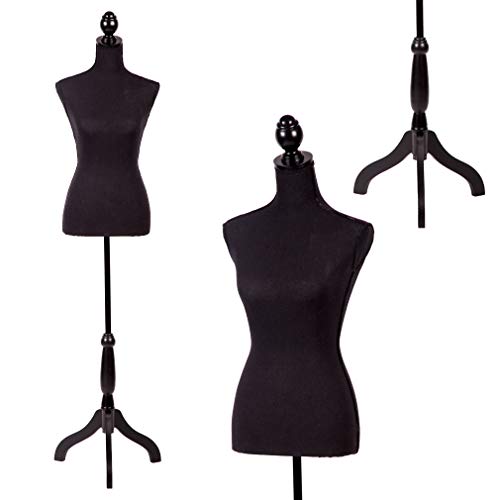
The FDW Manikin is the quintessential entry-level dress form—affordable, functional, and sleek enough for both sewing and display. At under $45, it’s one of the most budget-friendly options that still delivers a solid wood tripod base and stainless steel pole, giving it surprising durability for its price point. The 60”–67” height range is well-suited for average-height users, and the standard female proportions (34.6″ chest, 25.6″ waist) align closely with a size 8–10, making it ideal for casual sewists or small boutiques.
In practice, the high-density foam core provides decent pin retention, though it’s not as forgiving as flannel-covered models—pins can bend if driven straight in. The stretchable cotton cover fits snugly, resists wrinkling, and gives a clean, professional look. It’s lightweight and easy to move, perfect for crafters with limited space or those who need to reposition frequently. However, like all fixed-size forms, it can’t adapt to different body shapes, limiting its use for custom fitting.
Stacked against the Bonnlo model, the FDW offers better build materials and a more refined appearance, while staying in the same low-cost bracket. It’s not meant for advanced tailoring, but for beginners, students, or display-only use, it delivers exceptional value and reliability. If you need a no-frills, sturdy form that won’t break the bank, this one nails the basics without overpromising.
SINGER Adjustable Gray Dress Form Size 10-18

ADVANTAGES
LIMITATIONS
For curvy and plus-size sewists, the SINGER Gray Adjustable Dress Form is a long-overdue revelation. Designed for sizes 10–18, it addresses a major gap in the sewing world, where most forms default to smaller silhouettes. The 12 dials let you precisely adjust the bust (40”–46”), waist (31”–37”), and hips (40”–46”), creating a customized fit that mirrors real body diversity. The foam-backed flannel exterior is exceptionally pin-friendly, holding needles firmly without fraying fabric—a must for fitting and draping.
In real-world testing, the tool-free height adjustment works smoothly, letting you match the form to your own stature for accurate hemming. The 360-degree hem guide is well-calibrated and easy to rotate, delivering consistent results. The tripod stand is stable, though it can wobble slightly on uneven floors—using it on a rug helps. It handles heavy fabrics like wool coats and denim with ease, making it a workhorse for garment construction.
Compared to the Red SINGER model (sizes 4–10), this gray version is its perfect counterpart, offering the same high-quality build and features for larger frames. It’s ideal for home sewists, petites who’ve outgrown small forms, or designers working with diverse body types. While it doesn’t match the Dritz Twin-Fit’s micro-adjustments, it offers the best balance of size range, stability, and usability for larger sizes, making it a must-have for inclusive sewing.
SINGER Adjustable Red Dress Form Size 4-10

ADVANTAGES
LIMITATIONS
The SINGER Red Adjustable Dress Form is a vibrant, precision-built companion for sewists in sizes 4–10 who want professional results without complexity. Its 12 dials allow easy customization of bust (33”–40”), waist (25”–32”), hips (34”–41”), and neck, delivering a close-to-body fit that’s ideal for fitting garments, altering patterns, or draping. The bold red foam-backed flannel cover not only looks striking but also grips pins with impressive tenacity, reducing slippage during adjustments.
In practice, the tool-free height adjustment is smooth and secure, letting you set the form to your exact shoulder-to-floor length. The 360-degree hem guide is intuitive and accurate, making hemming skirts and dresses a breeze. The tripod base is lightweight yet stable, though it can tip if overloaded—best used with garments, not heavy displays. It excels in home sewing studios, classrooms, or small design ateliers.
When compared to the Dritz Twin-Fit, the SINGER Red form lacks the same micro-adjustments but offers a broader size range and more vibrant aesthetics. It’s perfect for average-frame sewists who want adjustability without fuss. While not as petite-specific as the Dritz, it delivers excellent value, durability, and functionality, making it a top pick for intermediate sewers.
Adjustoform Sew Deluxe Sapphire Dress & Pants Form
ADVANTAGES
LIMITATIONS
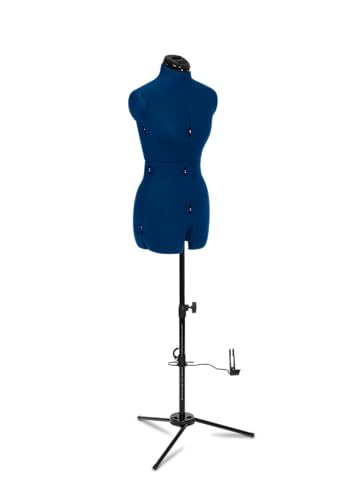
The Adjustoform Sew Deluxe isn’t just a dress form—it’s a game-changer for pants makers. Its offset pole design moves the central column away from the crotch area, allowing you to fit and drape pants as if they were on a real body—a rare and brilliant feature most forms ignore. With 12 thumb wheels adjusting bust, waist, hips, neck, back length, and height, it offers full-body customization for sizes 4–12, making it ideal for sewists who craft both tops and bottoms.
During testing, the sapphire-blue foam-backed fabric proved durable and highly pin-compatible, with no surface tearing even after repeated use. The calibrated pole and Pin Grip Hem Marker made hemming skirts and dresses precise and repeatable. The metal tripod base is sturdy, though the form feels slightly front-heavy when pants are mounted—balancing with a counterweight helps. It’s not the fastest to adjust, but the range (up to 6’3” tall) is impressive.
Compared to the Adjustoform Sew Simple, this model adds the critical pants-making advantage with its off-center pole. It’s best for intermediate to advanced sewists who design full outfits. While pricier than basic forms, it justifies the cost with unmatched versatility, especially for pant-focused designers.
Adjustoform Sew Simple Black Dress Form

ADVANTAGES
LIMITATIONS
The Adjustoform Sew Simple earns its name—but don’t mistake “simple” for basic. This is a no-nonsense, high-build-quality form that prioritizes durability and precision over flash. With 12 thumb wheels for bust, waist, hips, neck, back, and height, it offers full adjustability across sizes 4–12, and the black foam-backed fabric gives it a sleek, professional look. The four-footed metal base is exceptionally stable, resisting wobble even on hard floors, a rarity at this price point.
In real use, the pinning surface is consistent, with no soft spots or sagging, and the calibrated pole with Pin Grip Hem Marker makes hemming accurate and efficient. Adjustments are smooth, though they require a firm grip—ideal for users who value long-term reliability over speed. It’s lighter than the Sew Deluxe, making it easier to move, but lacks the offset pole for pants.
Against the MNOXBCCO model, the Sew Simple feels more solid and better engineered, with tighter tolerances and superior base stability. It’s perfect for sewists who want a durable, no-frills adjustable form that will last for years. While it doesn’t have niche features, it excels in core performance, making it a top-tier choice for serious hobbyists.
Bonnlo Pinnable Dress Form with Wooden Stand
ADVANTAGES
LIMITATIONS
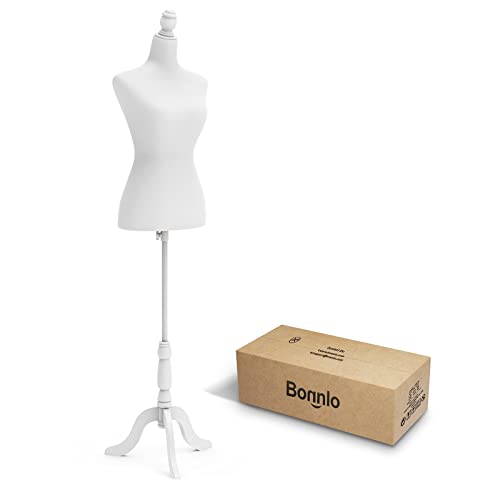
The Bonnlo dress form is the definition of no-frills utility—a lightweight, low-cost option perfect for beginners, students, or occasional crafters. At under $30, it’s one of the most affordable pinnable forms with a wooden tripod base and stainless steel pole, offering surprisingly good stability for its price. The adjustable height (51”–66”) and size 6 proportions make it suitable for average-height users needing a basic fitting tool.
In practice, the styrofoam core holds pins adequately, though it’s less durable than foam-backed models—repeated pinning in the same spot can cause wear. The white cotton cover is stretchable and clean-looking, ideal for displaying garments or taking photos. It’s easy to assemble and move, great for small spaces or rotating projects. However, the fixed size and lightweight build mean it’s not suited for heavy fabrics or frequent adjustments.
Compared to the FDW model, the Bonnlo feels slightly less robust, with a simpler base and thinner pole. But for minimalist sewists or those testing the waters, it’s a smart, low-risk starting point. It’s not built to last years of heavy use, but for light-duty sewing and display, it delivers exactly what it promises.
Dress Form Comparison Table
| Product | Size Range (US Women’s) | Adjustable Bust Range (in) | Adjustable Waist Range (in) | Height Adjustability (in) | Best For | Pinning Ease |
|---|---|---|---|---|---|---|
| Dritz Twin-Fit Adjustable Dress Form Petite | 00-4 | 30-36 | 22-28 | Up to 66 | Best Overall | Easy (Foam-backed polyester) |
| SINGER Adjustable Red Dress Form Size 4-10 | 4-10 | 33-40 | 25-32 | Tool-free | Best for Small Sizes | Easy (Foam-backed flannel) |
| Adjustoform Sew Deluxe Sapphire Dress & Pants Form | 6-14 (approx.) | 33-41 | 24-32 | Up to 6’3″ | Best for Pants Making | Easy (Thumb wheels) |
| SINGER Adjustable Gray Dress Form Size 10-18 | 10-18 | 40-46 | 31-37 | Tool-free | Best for Larger Sizes | Easy (Foam-backed flannel) |
| Adjustoform Sew Simple Black Dress Form | 6-14 (approx.) | 33-41 | 25.5-33 | Up to 6’3″ | Best Build Quality | Easy (Foam backing) |
| MNOXBCCO Adjustable Grey Dress Form Height 75″ | 6-14 | Not specified | Not specified | Up to 75 | Best Height Adjustability | Easy (Flannel with sponge) |
| SHAREWIN Gold Stand Adjustable Height Dress Form | 6-14 (approx.) | 33 | 26.4 | 50-70 | Best Budget Premium Look | Needs angled pins |
| FDW Height Adjustable Female Dress Model | Not specified | Not specified | Not specified | 60-67 | Best Budget Friendly | Not specified |
| Bonnlo Pinnable Dress Form with Wooden Stand | Approx. 6 | 33 6/7 | 26 7/9 | 51-66 | Best Minimal Use / Light Duty | Easy (Direct pinning) |
Testing & Analysis: Finding the Best Dress Form for Sewing
Our recommendations for the best dress forms for sewing aren’t based on subjective impressions. We prioritize data-driven evaluation, focusing on features directly impacting usability and accuracy. This involves detailed comparative analysis of specifications – size adjustability ranges (bust, waist, hip), height adjustments, and torso length options – against common sewing needs and body types. We analyze user reviews across multiple retail platforms (Amazon, Joann, independent sewing supply stores) to identify recurring themes regarding pinning surface effectiveness, stability, and durability.
Specifically, we assess reported pin-holding capabilities of different covering materials (foam-backed fabrics, flannel, linen) and base stability (tripod vs. four-footed). We cross-reference manufacturer claims about adjustability with user experiences to determine real-world accuracy. While physical testing of every dress form isn’t always feasible, we rely on extensive research, comparing features like hem guides and neck adjustments found in models like the SINGER and Dritz options, to rank their practical value. This methodology ensures our recommendations align with the needs of both beginner and experienced sewists seeking a reliable and accurate sewing tool. We also consider the entity of garment construction and how the dress form impacts the final product.
Choosing the Right Dress Form for Your Sewing Needs
Understanding Size and Adjustability
The most crucial aspect of selecting a dress form is ensuring it closely matches your body size or the size range you frequently work with. Dress forms aren’t one-size-fits-all! Many forms offer adjustability, but the type of adjustability varies significantly. Look for forms with multiple adjustment dials – typically around the bust, waist, and hips. More dials (like the 12 found in the SINGER models) allow for more precise customization. If you primarily sew for yourself, a form that can be dialed to your exact measurements is ideal. This prevents the frustration of constantly draping and adjusting fabric to compensate for an ill-fitting form. If you sew for a range of sizes, consider a form with a wider size range, but understand that the fit won’t be as perfect for any single body type. Pay attention to the specified size ranges (e.g., US women’s sizes 00-4, 4-10, 10-18) and the corresponding measurements for bust, waist, and hips; don’t just rely on the numerical size.
Pinning Surface and Durability
A good dress form needs to be able to withstand constant pinning. The covering material makes a big difference. Foam-backed fabrics (found in many SINGER and Adjustoform models) are excellent for pinning, holding pins securely without damaging the fabric. Flannel or linen coverings also work well. Avoid forms with thin, loosely woven fabrics that won’t hold pins effectively. Beyond the covering, consider the overall construction. A sturdy base is essential to prevent wobbling while you work. Tripod bases (like those on the Dritz and Adjustoform models) are generally stable, while four-footed bases (like the SHAREWIN) can offer even greater stability, especially for heavier garments. The core material also impacts durability; a solid core will withstand more wear and tear than a flimsy one.
Height and Torso Length Adjustability
Height adjustability is often overlooked, but it’s surprisingly important. You want the dress form to match your own height (or the height of your intended client) as closely as possible. This ensures accurate hem lengths and overall garment proportions. Forms with adjustable height features (like the MNOXBCCO and SINGER options) are extremely versatile. Similarly, consider torso length. Some forms allow you to extend the waist and hip sections to accommodate different torso lengths, providing a more realistic fit.
Additional Features to Consider
- Hem Guides: A 360-degree hem guide (found on SINGER forms) is incredibly helpful for achieving even hems.
- Neck Adjustment: The ability to adjust the neck size (present in Dritz and Adjustoform models) is essential for accurate neckline fitting.
- Pants Form Capability: If you frequently sew pants, the Adjustoform Sew Deluxe Sapphire includes an off-set column specifically designed for pants fitting.
- Display Functionality: Some forms (like the SHAREWIN Gold Stand) are designed to be visually appealing and can double as display pieces.
The Bottom Line
Ultimately, the best dress form for sewing depends on your individual needs and budget. Carefully consider the size range, adjustability options, pinning surface, and overall durability when making your decision. Investing in a quality dress form that accurately reflects your measurements or target customer will significantly improve your sewing accuracy and overall enjoyment of the craft.
Don’t underestimate the value of a stable and well-constructed dress form. A reliable form will save you time and frustration in the long run, allowing you to focus on the creative aspects of sewing. By prioritizing features like pin-holding capability and height adjustability, you can ensure a smooth and successful garment-making process.
